
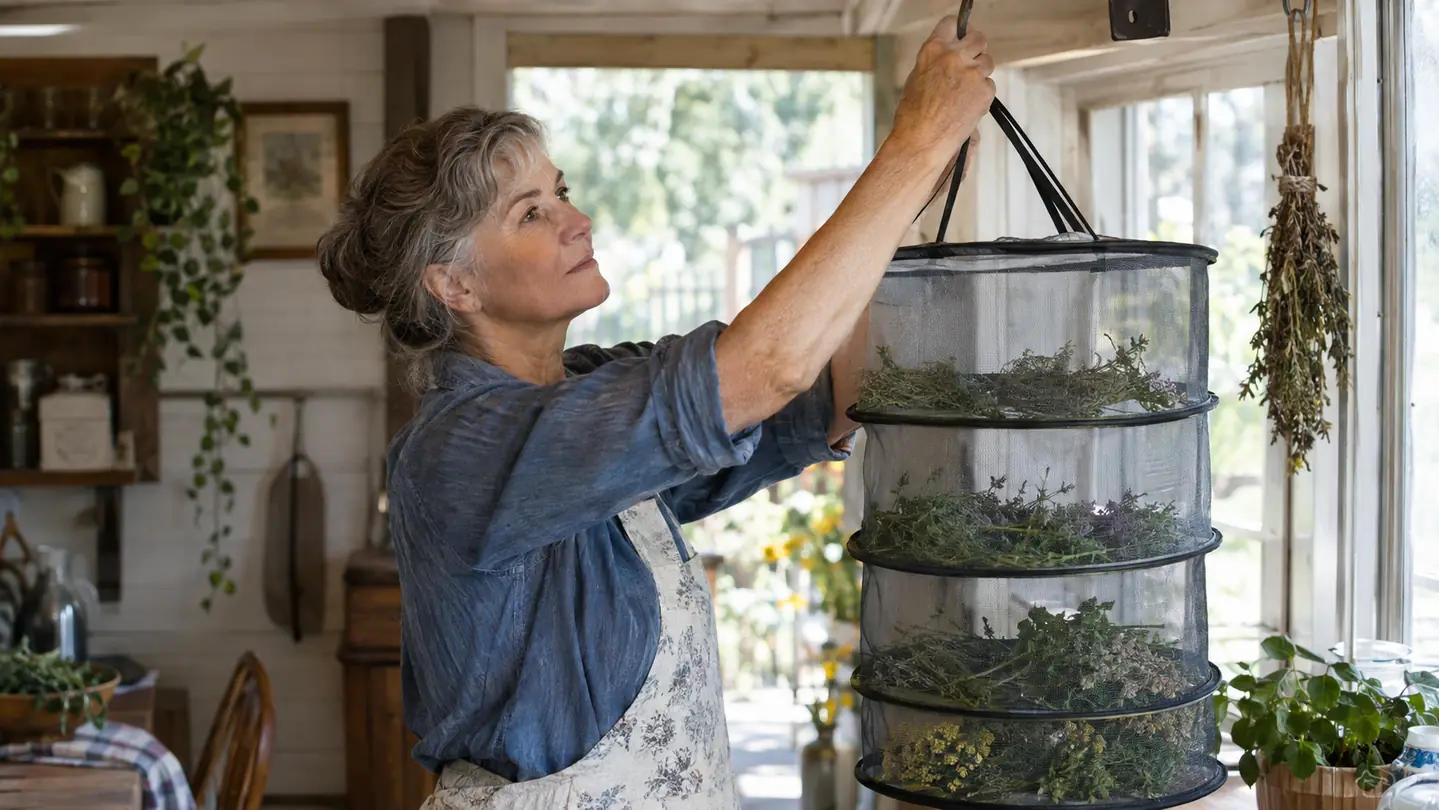
Every July my four raised beds run wild. The peppermint flops over the path, the lemon balm tries to take over the sage, and the thyme flowers before I can get to it. For years I handled the glut the way my grandmother did: I tied the stems into bundles with kitchen twine and hung them from the porch rafters. Then a friend brought over a Desy & Feeci mesh drying rack, and I spent the whole season drying the same harvest two ways to see which one really worked.
Short answer: the mesh rack dried herbs faster, kept more of their color and scent, and made the daily work easier. Bundles on a string still have a place in my kitchen, but for the bulk of my harvest, the rack wins. Here is what I learned drying peppermint, lemon balm, chamomile, thyme, rosemary and sage from July through October.
My verdict: The mesh rack dries herbs in about half the time of tied bundles, keeps them cleaner, and makes the daily work easier. I still hang a few bundles for decoration and for the herbs that look prettiest on a string, but the rack does the real work.
Skip the twine. Let the herbs breathe.
The Desy & Feeci 4-Layer Herb Drying Rack gives every sprig its own air, so your harvest dries faster and keeps more of its scent. That is what I reach for on harvest days now.
Amazon Check Today's Price on Amazon →How I Compared Them
I did not run this as a careful laboratory test. I ran it the way a home herbalist actually works, which means I made it up as I went and kept better notes than I expected to. It started on July 18, the morning the peppermint flopped over the path for the third time. I cut two grocery bags full of stems, carried them to the back porch, and split the pile in half. One half I tied into bundles of about eight stems each, the way my grandmother taught me, and hung them from the rafters with kitchen twine. The other half I laid loose into the Desy & Feeci rack, one herb to a layer, and hung the rack from a hook on the same porch. Same porch, same sun, same air. Then I checked both every day.
I repeated the same routine with every herb that came through the garden. Lemon balm went through the comparison in late July, chamomile in early August, then sage, rosemary and thyme as they came ready. I kept each herb on its own layer in the rack and tied its bundles with a different color of twine so I could tell them apart: white for peppermint, red for lemon balm, blue for chamomile. Every morning I walked the porch, gave the rack a quarter turn so no one side faced the window too long, and squeezed a leaf from each batch to see how it felt. In the evenings I did it again, because that is when the damp rolls in off the mountains and I wanted to see how each method handled the humidity.
I kept notes in a spiral notebook I still have, on three things: how many days until the leaves crumbled cleanly between my fingers, how the color held, and how the scent came through when I crushed a leaf. I also paid attention to the fuss factor, because a drying method I have to fight with is a method I will stop using by August. By the end of October I had run the same comparison on all six herbs, and the pattern held every single time.
| Desy & Feeci Mesh Rack | Tied Bundles on a String | |
|---|---|---|
| Drying time | Peppermint and lemon balm dry in 5 to 7 days on the porch | Same herbs take 10 to 14 days, and the inside of the bundle stays soft |
| Airflow | Every sprig has air around it on its own mesh layer | Only the outside of the bundle gets air; the middle stays damp |
| Mold risk | Low, because nothing sits against anything else | Real risk on humid days, especially with thick-stemmed herbs like sage |
| Daily fuss | Load it once, give it a turn every couple of days | Bundles need checking, and thick ones often need to be re-tied or taken apart |
| Storage after drying | Leaves fall loose and clean into a bowl, ready for jars | You have to strip each bundle by hand and pick out stems and twine |
| Looks | A working tool, not much to look at | A bundle of sage or rosemary on a string is genuinely pretty in the kitchen |
| Best for | Big harvests of leafy herbs like peppermint, lemon balm and chamomile | Small decorative bunches, sturdy herbs like rosemary, and herbs you want to hang where you can see them |
Where the Desy & Feeci Mesh Rack Wins
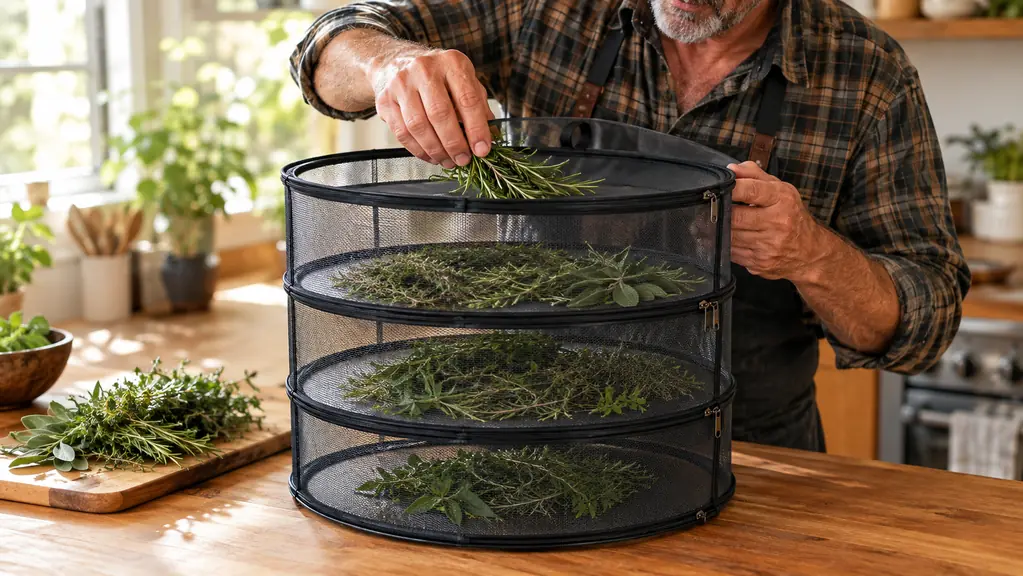
The rack wins on the two things that matter most: air and time. When herbs dry loose on a mesh layer, every leaf is exposed to moving air on both sides. My peppermint from July 18 was crisp in five days on the rack. The bundle I tied the same morning took twelve, and when I opened it up on day twelve, the inner leaves were still limp and starting to look tired. That is the difference between herbs that keep their green and their scent, and herbs that end up tasting like hay.
The same thing happened with lemon balm in August: five days on the rack, eleven in the bundle. Chamomile was the closest race, seven days on the rack against nine on the string, because those fine stems let air through even in a bundle. But the chamomile on the rack kept its apple scent, and the bundled chamomile smelled faintly of dust by the time it dried. Sage went the other way, ten days on the rack and fourteen in the bundle, and the bundled sage is the one that molded on me later in the season. Every herb I tested dried faster on the rack, and the ones that needed the most air showed the biggest difference.
It also wins on cleanliness. Drying herbs on a string means they hang in open air, catching dust and whatever drifts through the porch. The Desy & Feeci rack has a solid bottom layer, so the herbs sit in a shallow basket of mesh instead of swinging free. I have dropped a rack more than once without losing the harvest, which is more than I can say for a bundle that slips its twine. I also like that the rack keeps each herb separate. Peppermint on the top layer, chamomile in the middle, thyme on the bottom, and nothing touches anything else. With bundles, the flavors mingle on the outside of the string, and I always ended up with peppermint-scented sage or sage-scented peppermint. And when the leaves are dry, I just lift the rack over a bowl and run my hand through the herbs. The leaves fall loose, the stems stay behind, and I am done in two minutes. Ray timed me once, just to tease me, and it took ninety seconds to strip a whole layer into a quart jar.
The bundle I tied the same morning took twelve days, and when I opened it up, the inner leaves were still limp. That is the difference between herbs that keep their scent and herbs that taste like hay.
Where Tied Bundles Win
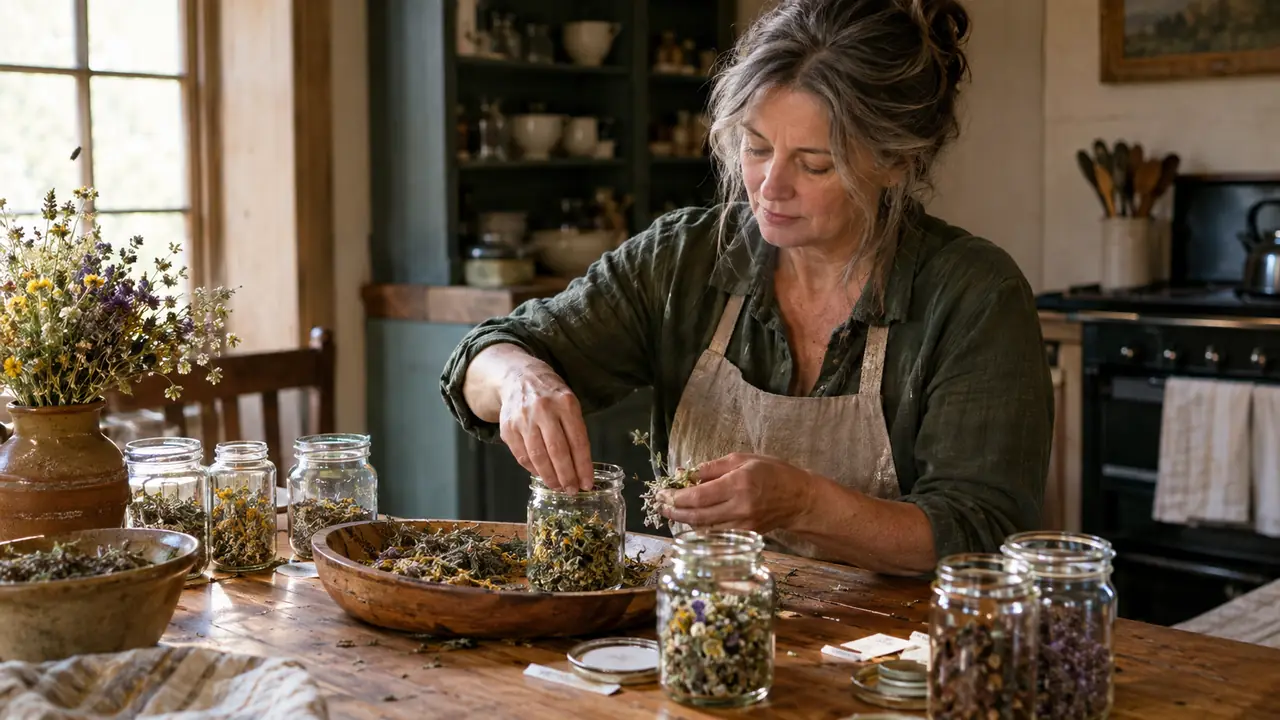
I am not ready to give up string entirely. A bundle of sage or rosemary hanging in the kitchen is pretty in a way a mesh rack is not, and for sturdy, woody herbs that do not need much air, a bundle dries just fine. My rosemary dried beautifully on a string all season, keeping its needles and its piney scent, because those stems are tough enough to stand up to a humid week. I also think bundles are the right choice when you only have a small handful of something. If I cut six sprigs of thyme for tonight's chicken, I am not setting up the rack. I am hanging a tiny bundle over the sink where I will see it and remember to use it. And in September, when I braid the garlic, I always tuck a few bundles of sage into the braid. That is tradition, and I am not giving it up.
The honest tradeoff is this: bundles are slower, and they demand more attention. On humid Shenandoah summer days, I have lost more than one bundle to mold, especially sage with its thick stems. The worst one was in early August, a bundle of sage I tied on a Tuesday and forgot about until Sunday. When I brought it down, the inside of the bundle was gray with mold and the leaves fell apart wet. I threw the whole thing in the compost and washed my hands twice. The rack has never once molded on me, not even in the sticky week we had in late July when the air did not move for days. So I use bundles for the herbs I want to look at, and the rack for the herbs I actually want to cook with and brew all winter.
Bundles also have a practical edge when you are drying something with a long stem that you want to keep whole. I dry calendula flowers on the rack because the petals fall off the moment they are crisp, but I hang a bundle of lavender stems over the pantry door every summer just to keep the moths out of the flour. That is not really about drying, it is about having the herb where you need it. The rack cannot do that for you.
Give your harvest room to breathe.
If you dry more than a few sprigs at a time, the Desy & Feeci 4-Layer Herb Drying Rack is the difference between herbs that keep their color and scent and herbs that dry uneven and dusty. It folds flat for storage, which matters in a farmhouse kitchen.
Amazon Check Today's Price on Amazon →Who Should Buy Which
Buy the Desy & Feeci mesh rack if you dry more than a handful of herbs at a time, if you grow leafy herbs like peppermint, lemon balm, chamomile or basil, or if you have ever opened a bundle to find mold or hay-scented leaves. It is also the better choice if you want to set the herbs and forget them for a few days. The four layers give you a lot of drying space in a small footprint. On a busy harvest day I have loaded all four layers at once, a full grocery bag of peppermint on top, lemon balm on the second, chamomile on the third, and thyme on the bottom, and the whole thing hung from one hook on the porch. When the season is over it folds flat, and I tuck it into the pantry behind the canning jars until next July.
Stick with bundles on a string if you dry small amounts, if you mostly grow woody herbs like rosemary and thyme, or if you simply like the look of herbs hanging in the kitchen. There is nothing wrong with that. I hang a braid of garlic and a bundle of sage every fall because it makes the kitchen feel like home. Just know that bundles will take longer, and you will need to keep an eye on them. If you live somewhere humid, check the inside of the bundle every couple of days and take it apart at the first sign of trouble.
One more thing I have learned the hard way: whatever method you use, dry herbs out of direct sun. Sun fades the color and pulls the scent right out of the leaves. My porch faces east, so the herbs get morning light and afternoon shade, and that has made more difference than any rack or string. I also strip the thickest stems before I lay herbs in the rack, because the leaves dry faster when they are not fighting a woody stem for moisture. That is the kind of small habit that separates a harvest you are proud of from a harvest you quietly give away.
One more note on capacity, because it surprised me. A full rack of peppermint dried down to about two quarts of crumbled leaves, which lasted us from August all the way to February. The same amount tied in bundles dried down to less, because I always lost some to mold or to stems I could not get clean. If you are drying for your own tea shelf and winter remedies, that difference matters more than any other detail in this article.
The rack that does the real work in my kitchen.
After a full season of drying the same harvest both ways, the Desy & Feeci 4-Layer Herb Drying Rack is what I reach for. Faster drying, cleaner herbs, and no mold. If that sounds like your kind of harvest day, it is worth a look.
Amazon Check Today's Price on Amazon →